
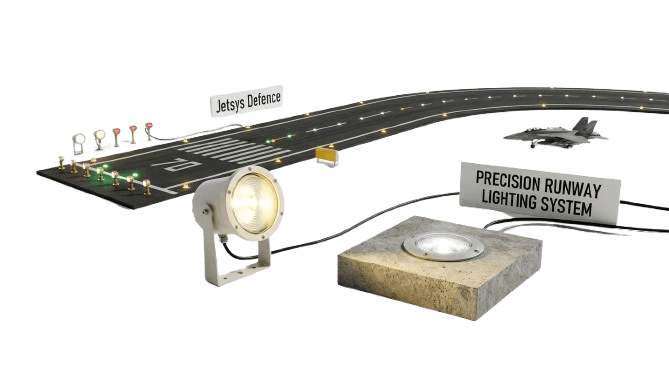
Elevated fixtures stand above the surface; inset fixtures sit flush within the pavement. Which one you need is almost always decided by whether aircraft run over that spot — not by preference, and not by cost.
This page covers where each type is used, how they differ in construction, installation, maintenance and cost, and how to work through the decision. For the wider system these fixtures belong to, see the airfield ground lighting page.
The Short Answer
- Elevated lights sit above the pavement on a frangible mounting, and are used where aircraft do not pass over them — runway and taxiway edges, thresholds, runway ends and approach lighting.
- Inset lights, also called in-pavement or semi-flush lights, sit flush with the surface and are used wherever aircraft wheels pass over them — runway and taxiway centrelines, touchdown zone, stop bars, and runway guard lights set across a taxiway.
- The deciding factor is almost never cost or preference. It is whether the fixture sits in the path of an aircraft, and after that, what the standard requires for that light type at that aerodrome.
- The trade-off in one line: elevated fixtures are cheaper, easier to install and easier to maintain; inset fixtures are the only option where aircraft cross, and they cost more at every stage of their life.
What Are Elevated Airfield Lights?
An elevated airfield light is a fixture whose light source sits above ground level, carried on a stem and mounted on a base beside the pavement.
The stem sits in a frangible coupling designed to shear or break away cleanly on impact, so that a strike damages the light rather than the aircraft. The frangible point is kept low — no higher than three inches above grade in the applicable FAA installation details — and some coupling designs build in a fluid barrier to keep rainwater out of the base below once the coupling has broken. On elevated runway guard lights, a tether is sometimes added so that a fixture whose column breaks under jet blast is not blown onto a neighbouring runway or taxiway.
Mounting heights vary, and extended-height versions exist for good reasons: snow regions where accumulation would bury a standard fixture, raised shoulders, and sight lines over uneven ground.
In FAA terms the elevated families are L-860 low intensity, L-861 medium intensity for runway and taxiway edges, and L-862 high intensity runway edge, each with suffixed variants for threshold, taxiway and other applications — plus L-804 for the elevated runway guard light, which flashes alternately in yellow.
The practical advantage is worth stating plainly, because it drives most of the cost and maintenance difference that follows: the whole fixture is accessible from above ground, at standing height, without touching the pavement.
What Are Inset (In-Pavement) Airfield Lights?
An inset airfield light is a fixture whose light source sits flush with, or slightly recessed below, the pavement surface. Inset and in-pavement mean the same thing and are used interchangeably across standards and manufacturers; the FAA specification calls them semi-flush light assemblies, which is the third term you will meet.
That third name is the honest one, because these fixtures are not perfectly flush. A small maximum projection above the surface is permitted — a fraction of an inch — and the fixture is designed and installed to stay within it.
What that shape has to achieve is the whole story of this page: survive being driven over at speed by a fully loaded aircraft, stay sealed against water, and still project a usable beam from almost nothing above the surface.
In FAA terms the in-pavement families are L-850 for runway lights — with classes covering bidirectional centreline, unidirectional touchdown zone, bidirectional edge and threshold variants — and L-852 for taxiway lights, covering centreline on straight and curved sections, clearance bars, taxiway edge, stop bars, and in-pavement runway guard lights. Several types carry an -S suffix for the shallow-base version of the same fixture.
Inset fixtures are used anywhere aircraft wheels cross the line of lights. One trend worth a single sentence of context: some large airports have moved toward all-inset layouts on parts of the airfield, for obstacle-free surfaces and less strike damage. It is a notable direction of travel, not the norm, and nothing on this page rests on it.
Inset vs Elevated: Side-by-Side Comparison
Scroll to see all columns
| Factor | Elevated | Inset (in-pavement) |
|---|---|---|
| Position relative to the surface | Above the pavement, on a stem and base | Flush with the surface, within the pavement |
| Where it is used | Beside the pavement, where nothing runs over it | Wherever aircraft wheels cross the line of lights |
| Can aircraft run over it | No — it is an obstacle if they do | Yes — that is what it is built for |
| Typical fixture cost | Lower | Significantly higher |
| Installation cost and civil works | Lower — base beside the pavement | Much higher — coring or casting into the pavement, ducting, reinstatement |
| Installation and replacement time | Short | Long, and inside a closure |
| Pavement work required | None, or minimal | Core drilling or cast-in base, cable slots, surface reinstatement |
| Maintenance access | From above ground at standing height, often without a closure | Requires pavement access and usually a closure |
| Maintenance frequency | Lower | Higher — cleaning, seal checks, seating checks |
| Vulnerability to vehicle and jet blast damage | Higher — it stands in the open and gets struck | Lower — nothing to strike |
| Vulnerability to water ingress | Lower | Higher — the dominant failure mode |
| Performance in snow and standing water | Stands above accumulation | Can be submerged or buried; may need heating in cold climates |
| Obstacle risk to aircraft | Present, mitigated by frangibility | None |
| Alignment sensitivity | Higher — aiming across all axes needs periodic attention | Lower in service, but seating and height matter |
| Optical performance and beam control | Freer — optics can sit at a convenient height and aim widely | Constrained — a shallow beam through a prism from millimetres above the surface |
| Service life expectation | Longer, absent impact damage | Shorter, governed largely by seal integrity |
Read that table for cost, programme and maintenance load — not for a winner. These are not competing products to choose between on merit. The standard and the geometry decide which one you need; the comparison matters for understanding what that decision commits you to afterwards.
The one real design choice that does exist sits in the handful of light types that are available in both forms, as described in the next section.
Which Airfield Lights Are Inset and Which Are Elevated?
Several light types exist in both forms, and runway guard lights are the clearest example. A runway guard light may be a pair of elevated alternately flashing yellow lights, one either side of the taxiway, or a row of in-pavement lights across it. The two serve the same purpose and are generally not both installed at the same runway holding position — though it can be advantageous to supplement in-pavement units with elevated ones where visibility of the holding position needs reinforcing.
The light's function does not dictate the fixture type on its own. Pavement width, whether aircraft actually cross that line, the approach category and the aerodrome's own layout all feed into it. That is why fixture type is settled in the lighting design rather than chosen product by product, and why the appropriate fixture can differ between installations.
The Engineering Difference: Why Inset Fixtures Are the Harder Product
An elevated fixture is a sealed light on a pole. An inset fixture is a sealed, load-bearing, thermally cycled pressure vessel that must also be an accurate optical instrument — and that is why it typically costs more.
Wheel Loading and Static Load
An inset fixture is driven over by aircraft at speed, carrying the full weight on a small contact patch. Load-bearing capability is a tested requirement, not a design claim: the qualification programme covers static load, hydraulic impact, shock and vibration.
The base is a structural element rather than a housing, and the detail that shows the engineering is what it is designed to resist. An inset base has to stay put in two directions at once — it must not rotate in the pavement under the twisting load of a turning wheel, and it must not lift out of it. Castings carry specific features for each: recesses that key the base into the surrounding epoxy or concrete against rotation, and a flange that resists uplift. Elevated fixtures face none of this.
The standards reflect the split. The FAA fixture specification addresses drainage and electrical requirements separately for elevated and in-pavement lights, and the elevated base and stake-mounting test requirements sit in the light bases specification rather than the fixture one. Two different products under one document.
Thermal Shock and Sealing
This is the effect readers find most surprising, and it is worth explaining properly.
An inset fixture sitting in sun-heated pavement can be hit by cold rain within seconds. As the internal volume contracts, the pressure differential pulls air — and any water present — past an imperfect seal. Thermal shock is a specific qualification test for these fixtures, alongside exposure to high relative humidity including condensation, and the top assembly must be sealed.
The practical consequence is worth stating bluntly: sealing is not a feature on an inset fixture. It is the component most likely to end its life.
Water Ingress and Drainage
An inset fixture sits at the lowest point of a surface specifically designed to shed water, so it spends part of its life submerged. These fixtures carry high ingress protection ratings as a result, and the better designs add features aimed squarely at the problem: shallow channels in front of the prism windows so that heavy rainfall sheets away rather than standing over the beam path, and seal placement outside the dome so that dirt does not collect between the fixture and its base.
None of that eliminates it. Water ingress following seal degradation is the most common cause of inset fixture failure, and no amount of specification removes it entirely — which is why the maintenance regime matters as much as the purchase decision.
The Optical Constraint of a Flush Fixture
An elevated fixture can place its optics at a convenient height and aim them freely. An inset fixture must project its beam from a few millimetres above the surface, through a prism, at the shallow vertical angles a pilot's eye position requires. That constrains the optical design severely, and it has a maintenance consequence: because the usable beam leaves through a small window close to the ground, inset fixtures are far more sensitive to dirt, scratching and rubber deposits than elevated ones. A contaminated prism loses output where it matters most.
One cold-climate note for completeness: inset fixtures in snow and ice regions may need internal heating to stay visible, which elevated fixtures largely avoid by standing above the accumulation. That is a genuine design factor in some markets and has limited relevance to most Indian airfields — worth saying rather than implying it applies everywhere.
Installation: Bases, Mounting and Civil Works
Elevated: Frangible Couplings and Stems
An elevated fixture is installed on a base beside the pavement, with a frangible coupling, a stem carrying the fixture, and the electrical connection made through an isolation transformer in the base.
Two installation details matter more than they look. First, the frangible coupling, the cable clamp and the cable assembly are difficult to verify once the work is finished and the base is closed — which is why they are inspected during installation rather than afterwards. Get it wrong and nobody finds out until a fixture is struck and the coupling does not behave as intended.
Second, and this is the kind of detail that only comes from doing the work: removing a seized frangible coupling is one of the most awkward jobs in airfield lighting maintenance. Anti-seize compound applied at installation costs almost nothing and saves real time years later, on a job that will otherwise be done at night against a closure clock.
Inset: Shallow Base and Deep Base
Three installation routes, and the distinction specifiers actually ask about:
- Deep base. Used in new concrete pavement construction. The base is longer than the pavement is thick, with its lower section set into concrete to anchor it and brace it against movement during paving. The standard approach when the pavement is being built.
- Shallow base. A smaller, lighter base bonded into a hole cut in existing pavement, typically with epoxy. The standard approach for a retrofit, and workable in both flexible and rigid pavements. Many inset fixtures have a dedicated shallow-base variant — the -S suffix in the FAA type designations.
- Direct installation. Some fixtures are designed to fit straight into a cored hole without a separate mounting base.
The FAA designates the base cans themselves: L-867 non-load-bearing, for elevated fixtures beside the pavement, and L-868 load-bearing, for inset fixtures in it. The difference in name is the whole difference in product.
One recurring theme worth repeating: on a retrofit, base selection is usually dictated by what is already in the pavement rather than chosen freely. The existing bases decide a great deal about what can be installed and how long it takes.
Installation Effort and Closure Windows
This is the practical difference that drives project cost.
An elevated fixture is installed beside the pavement. An inset fixture requires coring or cutting into a runway or taxiway, setting and bonding a base, running cable through ducts or saw-cut slots, and reinstating the surface — all of it inside a closure window, often at night, with the surface fully serviceable again by morning.
The conclusion is worth making explicit, because it is the single most useful thing on this page for anyone planning a project: the cost difference between elevated and inset is far larger in installation than in the fixtures themselves, and the operational cost of the closures is frequently larger still. On a single-runway airport that is often the deciding constraint on how a lighting project is phased — not the budget, the available night hours.
Maintenance: What Each Type Demands
The regulators themselves state the finding this section rests on: in-pavement fixtures generally need more maintenance than elevated ones to give consistent performance and uniformity of output, while elevated fixtures need more care in alignment across all axes. Maintenance guidance treats load-bearing in-pavement fixtures as a category with their own requirements, separate from elevated edge lighting.
The two types do not fail in the same way, and a maintenance programme that treats them as one subject will under-serve both.
What Inset Fixtures Demand
- Cleaning. Prisms pick up dirt, rubber deposits and scratching from traffic, and measured output falls as a result. There is published guidance specifically on determining degradation and cleaning of centreline and touchdown zone lights, aimed at detecting when fixtures have dropped below an acceptable intensity — which tells you how routine the problem is.
- Seal and water-ingress checks. The dominant failure mode, so the dominant check.
- Fixture height and seating checks. A fixture sitting proud of the surface or loose in its base is both an output problem and an inspection finding, and it is a FOD risk besides.
- Pavement access for every job. Not a vehicle beside the pavement — a closure. Every task carries that overhead, which is why inset maintenance is planned in batches rather than attended to as faults arise.
What Elevated Fixtures Demand
- Aiming and alignment. Elevated runway edge and threshold fixtures need alignment across all axes, and a drifted aim degrades the pattern a pilot sees without any fault being visible to a technician or reported by any monitoring system.
- Impact damage. From ground vehicles and jet blast, with frangible coupling replacement after a strike.
- Seized couplings. The specific problem named above — removing one is among the most troublesome tasks in airfield lighting repair, which is why anti-seize compound at installation earns its place.
- The compensating advantage. The work happens at standing height, beside the pavement, frequently without closing anything. That single fact accounts for much of the maintenance cost difference.
What Changes With LED
Moving a circuit from halogen to LED changes the balance for both types, because relamping disappears from the schedule and what remains is cleaning, sealing and alignment.
The effect is asymmetric, and that is the useful observation. On inset fixtures it shifts the workload rather than removing it — cleaning and seal checks were always the larger part, and they remain. On elevated fixtures it can nearly empty the routine, leaving aiming checks and strike response.
For the wider maintenance and serviceability picture — including the regulated serviceability levels that decide how many lights may be unserviceable before an approach category is downgraded — see the airfield ground lighting page.
Cost: Purchase, Installation and Whole Life
The cost difference between inset and elevated fixtures sits in four layers, and the first is the smallest.
- The fixture. Inset fixtures cost significantly more than elevated equivalents, for every engineering reason set out above — load-bearing construction, sealing, thermal qualification and constrained optics.
- Installation. Where the gap widens sharply. Coring or casting a base into pavement, cable routing through ducts or saw-cut slots, bonding, levelling and surface reinstatement, against an elevated fixture set on a base beside the pavement.
- The operational cost of installing. The closure windows inset work requires. On a constrained airfield this can exceed the construction cost in value terms, because what is being consumed is runway or taxiway availability rather than money.
- Maintenance over life. Higher for inset fixtures on both counts — more frequent attention, and every visit carrying pavement access.
And the counterweight, stated fairly, because the cost case is not all one way. Elevated fixtures stand in the open and get struck — by ground vehicles, by jet blast, occasionally by aircraft. A damaged elevated fixture with a seized frangible coupling is not a trivial repair either, and an airfield with a high vehicle movement rate will replace elevated fixtures and couplings on a cycle that inset fixtures never generate.
How to Decide: A Short Selection Guide
In the order the questions actually get asked:
- Will aircraft run over this line of lights? If yes, the fixtures are inset. This answers most cases on its own, and it is worth asking first precisely because it closes the question so often.
- What does the standard require for this light type at this aerodrome? Several light types have a conventional form, and a few permit either. The lighting design settles it, not the catalogue.
- What is the pavement situation? New construction allows deep bases and designed-in ducting. A retrofit into existing pavement points to shallow bases, and shapes both the cost and the programme.
- What closure time is available? If the answer is very little, it changes the phasing, sometimes the base choice, and occasionally the scope of what is attempted in one season.
- What can the maintenance team actually sustain? Inset fixtures carry a real recurring workload with pavement access attached. A design that assumes resources the airfield does not have will degrade, and a degraded in-pavement system shows up as a serviceability finding.
- What is already installed? Matching existing bases, fixtures and spares holding is usually worth more than a marginally better fixture, because a standardised estate is cheaper to run for decades.
For the full specification and selection discussion — photometric performance, regulator compatibility, monitoring, total cost of ownership — see the airfield ground lighting page, which owns that ground.
Frequently Asked Questions
1. What is the difference between inset and elevated airfield lights?
Elevated fixtures sit above the pavement on a frangible mounting; inset fixtures sit flush within the pavement surface. The distinction is driven by whether aircraft run over that line of lights, not by preference or cost.
2. Are in-pavement lights the same as inset lights?
Yes. Inset, in-pavement and semi-flush all describe the same fixture type, and standards and manufacturers use the terms interchangeably — the FAA specification uses "semi-flush". There is no product difference behind the different names.
3. Which airfield lights are inset and which are elevated?
Centrelines, touchdown zone lights, stop bars and rapid exit taxiway indicators are inset. Runway and taxiway edges, thresholds, runway ends, approach lighting and visual slope indicators are normally elevated. Several types exist in both forms, so check the applicable standard and approved layout.
4. Why are runway centreline lights inset rather than elevated?
Because aircraft run directly along the centreline. An elevated fixture there would be struck on every landing, and would itself be an obstacle in the path of the aircraft. The same logic applies to touchdown zone lights and to stop bars crossing a taxiway.
5. Are inset lights more expensive than elevated lights?
Yes, at every stage — the fixture, the installation and the maintenance over its life. The gap is widest not in the fixture but in the installation and the pavement closures it requires, which on a busy airfield is the largest cost of all.
6. Why do elevated airfield lights have to be frangible?
So that a strike damages the light rather than the aircraft. The coupling is designed to shear cleanly on impact, and the frangible point is kept low — no higher than three inches above grade in the applicable FAA installation details. It is a regulated, tested requirement that applies to the mounting as much as to the fixture.
7. What is the difference between a shallow base and a deep base?
A deep base is set into concrete during new pavement construction and anchors the fixture through the full pavement depth. A shallow base is bonded into a hole cut in existing pavement, typically with epoxy, and is the usual retrofit route. On a retrofit the existing pavement generally decides which is possible.
8. Why do inset airfield lights fail more often than elevated ones?
Because of what they endure: aircraft wheel loading, thermal shock when cold rain hits hot pavement, standing water, and dirt and rubber deposits on the optical surface. Water ingress following seal degradation is the dominant failure mode, and sealing is the component that usually ends the fixture's life.
9. Can an elevated light be replaced with an inset one, or the other way round?
Not as a straight swap. Fixture type follows the lighting design and the geometry, so changing it means new bases, new cabling and in most cases regulatory approval for the change. Replacing like with like is the normal route, and the one that keeps an approval valid.
10. Which type needs more maintenance?
Inset fixtures, on both frequency and access cost, because every job needs pavement access. But the balance matters: elevated fixtures need more attention to aiming, and a strike with a seized frangible coupling is a slow repair. The work is different in kind rather than simply greater on one side.