
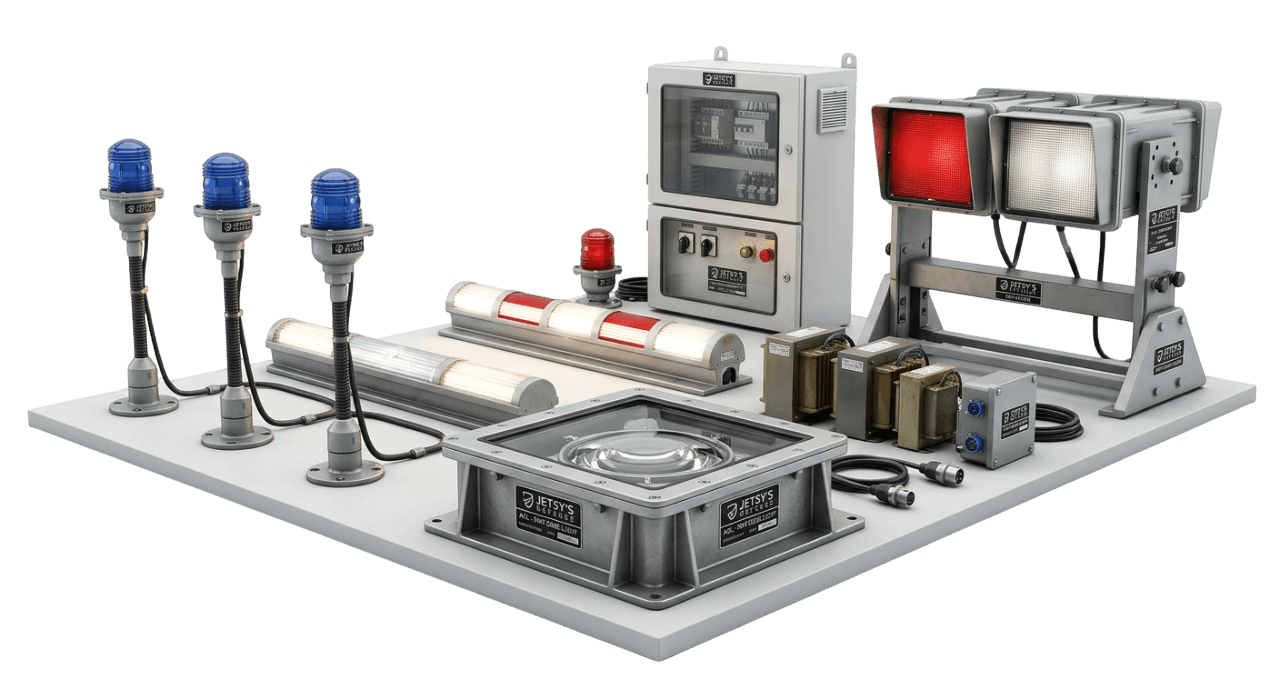
A pilot on final approach in poor visibility is flying on a pattern of coloured lights. Within seconds that pattern has to tell them where the runway is, where its edges and centreline run, how much of it is left, whether they are high or low on the glide path, and which taxiway to turn onto after landing. Airfield ground lighting is the system that puts that pattern on the ground and keeps it there, every night and in every condition the aerodrome is approved to operate in.
It is the complete set of lights, signs, power supplies and control equipment that provides visual guidance on and around an aerodrome — approach lighting, runway and taxiway lighting, visual slope indicators, signs, beacons and obstruction lighting. One thing surprises most people new to the subject: these lights are not wired like building lighting. They run on constant-current series circuits, which the page explains further down.
This page is written for airport operators and engineering teams, aerodrome consultants and specifiers, EPC and electrical contractors, defence airfield engineers, and maintenance teams sourcing spares. Jetsys Defence supplies airfield ground lighting fixtures, signs, components and spares from Navi Mumbai.
What Is Airfield Ground Lighting?
Airfield ground lighting is the complete system of lights, signs, power supplies and controls that gives pilots visual guidance for approach, landing, taxiing and take-off at an aerodrome.
In operational terms it does five things. It establishes the runway's position and alignment from the air, before the runway itself is visible. It defines the runway's edges and centreline. It indicates how much runway remains. It shows whether the aircraft is on, above or below the correct glide path. And once the aircraft is down, it routes it safely to the stand without entering a runway it has not been cleared onto.
It matters most at night and in low visibility, where it stops being helpful and becomes the primary means of guidance. That is the link worth holding on to throughout this page: the operating minima an aerodrome can offer — how poor the visibility can get before it stops accepting traffic — are tied directly to the lighting installed on it.
And the system is a good deal more than fixtures. The power supply, the series circuits and the control and monitoring equipment are as much part of airfield ground lighting as the lights themselves, and are where most of the engineering actually sits.
AGL, Aeronautical Ground Lighting and Airfield Lighting: The Same System, Different Names
The variants are all searched, and all appear in tenders, sometimes in the same document.
- Airfield ground lighting / AGL — the standard industry term, and the one used throughout this page.
- Aeronautical ground lighting — the regulatory phrasing, used in ICAO and IEC documents.
- Airfield lighting / airport ground lighting / runway lighting system — common usage, frequently meaning the whole installation even when only runway lights are named.
- Visual aids — the ICAO category heading, which also covers markings, signs and markers.
- AGL system / airfield lighting system — the complete installation including power supply and control equipment.
When a tender names one of these, it usually means all of them. The useful question is not which term was used, but which lighting elements and which standard the specification actually calls for.
The Elements of an Airfield Ground Lighting System
Approach Lighting Systems
Configurations of lights extending outward from the threshold into the approach area, giving the pilot alignment, roll guidance and distance-to-threshold cues before the runway itself is visible. A simple approach lighting system provides a centreline and a crossbar; precision approach systems add further crossbars, side rows and in some configurations sequenced flashing lights.
Two points matter commercially. Configuration and length scale with the approach category, and the approach lighting system is one of the principal factors in how low the aerodrome's minima can go.
Runway Lighting
The core group, and what each element tells the pilot:
- Runway edge lights outline the usable width of the runway along its full length.
- Threshold lights and threshold wing bars mark where the landing surface begins, seen from the approach.
- Runway end lights mark where it ends, seen from the runway.
- Runway centreline lights guide the roll-out and, through their colour coding, tell the pilot how much runway remains without reference to any other instrument.
- Touchdown zone lights define the area where the aircraft should touch down, and are a Category II and III requirement.
- Rapid exit taxiway indicator lights count the aircraft down to the next high-speed exit, which is a runway occupancy and capacity measure as much as a guidance one.
Taxiway Lighting
Taxiway edge lights, taxiway centreline lights, stop bars, runway guard lights and intersection lighting. This group exists substantially to prevent runway incursions — an aircraft or vehicle entering a runway without clearance, which remains one of aviation's most persistent serious-incident categories.
That is why stop bars and runway guard lights are not optional extras at lower visibility: they are the physical mechanism by which a clearance is made unambiguous at a holding position.
Visual Approach Slope Indicators
Precision approach path indicators, and their abbreviated variants for shorter runways, give the pilot a continuous visual signal of vertical position relative to the correct approach slope through a combination of red and white lights. The signal is readable at a glance from several miles out, and it works without any avionics on the aircraft at all — which is why it remains fitted even at runways with full instrument approaches.
Alignment is the critical property. A unit out of adjustment by a fraction of a degree is giving the pilot wrong information with complete confidence, which is why aiming checks are a recurring maintenance item rather than a commissioning one.
Airfield Signs and Markers
Internally illuminated mandatory instruction signs, information and direction signs, and the markers used where a sign or a light is impractical. Mandatory instruction signs carry white characters on red; information and direction signs carry black on yellow or yellow on black depending on function.
The engineering point: signs are typically powered from the same constant-current series circuits as the lights, and must hold their brightness independently of the circuit's brightness step. That has real consequences for circuit loading and for which sign designs are compatible with a given installation.
Aerodrome Beacons, Wind Direction Indicators and Apron Floodlighting
The aerodrome beacon identifies the airfield from a distance, flashing in a characteristic colour sequence. Illuminated wind cones give wind direction and approximate strength at the point it matters, and are lit at any aerodrome intended for night use. Apron and stand floodlighting covers ground handling, servicing and aircraft movement on the apron — lower in regulatory profile than the movement area lighting, and a significant share of an airfield's connected lighting load.
Obstruction Lighting
Lighting on buildings, masts, towers, cranes and other obstacles in and around the aerodrome, with type and intensity graded by the obstacle's height and position. Low, medium and high intensity obstacle lights serve different cases, and temporary obstacles such as construction cranes are a recurring requirement at an operating airport rather than a one-off installation.
The Airfield Light Colour Code: What Each Colour Means
The colour code is standardised internationally so that a pilot reads the same meaning from the same colour at any aerodrome in the world. That is why it is specified so tightly, and why a replacement fitting has to meet the chromaticity boundaries for aeronautical ground lights rather than simply look about right. A fixture that is visibly the correct colour and falls outside the specified boundary is not compliant.
How an Airfield Ground Lighting System Works
Why Airfield Lights Run on a Series Circuit
Airfield lights are not wired in parallel like building lighting. A single cable loop runs from the lighting vault out to every fixture on the circuit and back again, and the supply holds the current constant while the voltage varies with the load.
The reason is distance. A runway circuit can run for kilometres and carry dozens of fixtures. On a constant-voltage circuit, voltage drop along that cable would leave the lights furthest from the supply visibly dimmer than those nearest it — unacceptable when the pilot is reading brightness and pattern as information. On a constant-current circuit every fixture in the loop carries the same current, so every light is equally bright regardless of where it sits.
Two consequences follow, and they shape everything else about airfield electrical design:
- Each fixture connects to the loop through its own series isolation transformer, so a failed lamp does not break the loop and extinguish the entire circuit.
- Dimming is done by changing the circuit current, which is why airfield lighting intensity comes in discrete steps rather than on a continuous slider.
The Constant Current Regulator
The constant current regulator (CCR) is the power source for each circuit, delivering a precise, selectable current into the series loop. The long-established nominal value is 6.6 A at full brightness, and the entire equipment ecosystem — fixtures, lamps, isolation transformers and regulators — is built around it.
The FAA specification for constant current regulators and regulator monitors classifies the equipment in a way that Indian tenders frequently reference directly:
- L-827 — regulator monitor
- L-828 — regulator without monitoring
- L-829 — regulator with monitoring
- Class 1 — 6.6 A output current; Class 2 — 20.0 A output current
- Style 1 — three brightness steps; Style 2 — five brightness steps
Regulators are rated by output power in kVA and sized to the circuit load, and a large airport may run a substantial number of them — typically one or more per lighting circuit. One modern caveat worth knowing: regulator output waveform quality matters more with LED fixtures and illuminated signs than it ever did with filament lamps, which is why an LED retrofit on an older vault is an electrical compatibility exercise rather than a lamp swap.
Series Isolation Transformers and Primary Cable
Each fixture is fed through a series isolation transformer, which takes current from the primary loop and delivers it to the lamp at a limited secondary voltage. It achieves two things at once:
- It isolates each fixture electrically from the primary circuit, which carries a high voltage.
- It keeps a lamp failure from opening the circuit, because the transformer's primary winding remains in the loop.
Transformer VA rating is matched to the fixture load, and this is where LED retrofits catch people out: an LED fixture drawing a fraction of the power of the halogen unit it replaces may be badly mismatched to the installed transformer. Primary cable rating, insulation class and the connector type used at each transformer are specified alongside it.
Brightness Steps and Intensity Control
Intensity is selected from the tower according to visibility and time of day, with each step corresponding to a defined circuit current. Runway circuits typically offer more steps than taxiway circuits — the FAA classification above distinguishes three-step from five-step regulators on exactly this basis.
The operational point is one that surprises people outside airport operations: over-bright lighting in good visibility is a genuine problem, not a harmless margin. Lighting set too high at night degrades a pilot's dark adaptation and can obscure rather than reveal the pattern. The step is selected for the conditions, both up and down.
Control and Monitoring: ALCMS and ILCMS
Two related but distinct capabilities, routinely confused in enquiries.
Airfield lighting control and monitoring system (ALCMS) is the interface between air traffic control, the maintenance team and the lighting vault. It selects circuits and brightness steps, reports circuit status, and logs what was selected and when.
Individual lamp control and monitoring (ILCMS) monitors — and in some systems switches — each fixture individually, so a failed lamp is identified by its position rather than inferred from a circuit-level alarm.
Why the distinction matters operationally: in low visibility the pattern a pilot reads depends on specific lights working, and the regulations treat adjacent failures far more seriously than scattered ones, because two failures side by side create a gap in the pattern. A circuit-level alarm cannot tell you whether three failures are spread across a kilometre or sitting next to each other. Individual lamp monitoring can, which is why it becomes necessary as minima tighten.
Secondary Power Supply and Changeover Time
A standby supply is part of the lighting system rather than a building service, and the permitted changeover time tightens sharply as the approach category increases.
Standards and Regulations That Govern Airfield Ground Lighting
ICAO Annex 14 and the Aerodrome Design Manual
ICAO Annex 14, Volume I, Aerodrome Design and Operations is the global baseline. Its visual aids chapter specifies each lighting system — where lights are located, what colour they show, how they are spaced and when each system is required. Its appendices define the colours for aeronautical ground lights and the light characteristics, including the intensity distributions each fixture type must meet. Chapter 10 covers maintenance and the serviceability levels discussed further down this page.
ICAO Doc 9157, Aerodrome Design Manual, Part 4 — Visual Aids is the accompanying guidance on applying those specifications in practice. Part 5 — Electrical Systems covers the electrical side, including series circuits and power supplies.
FAA Advisory Circulars and the L-Series Equipment Specifications
The FAA 150/5345 series specifies individual equipment items, each identified by an L-number. Those designations are used in tenders well outside the United States, Indian tenders included, so they are worth recognising even on an ICAO-based installation:
- AC 150/5345-10, Specification for Constant Current Regulators and Regulator Monitors — the source of the L-827, L-828 and L-829 designations and the class and style classification above. The current revision is H, dated 2014.
- AC 150/5345-53, Airport Lighting Equipment Certification Program — the programme under which airfield lighting equipment is certified, and the reference behind a great many compliance claims.
- AC 150/5345-47, Isolation Transformers for Airport Lighting Systems.
IEC Standards for AGL Electrical Installations
The IEC 61820 series, Electrical installations for lighting and beaconing of aerodromes, covers the electrical installation. IEC 61822 previously specified the requirements for a constant current regulator with a nominal 6.6 A output for an aeronautical ground lighting series circuit — but IEC 61822 was withdrawn in October 2023 and replaced by IEC 61820-3-2:2023, Requirements for power supplies — Particular requirements for series circuits, which specifies requirements for power electronic converter systems powering AGL series circuits, a traditional implementation being the 6.6 A circuit.
If a specification or a tender in front of you still cites IEC 61822, that is worth raising. It is not a trivial renumbering: the replacement standard is written around power electronic converters rather than the ferroresonant regulators the older document assumed.
The Indian Framework: DGCA, AAI and BIS
- AAI. The Airports Authority of India issues its own technical specifications for equipment supplied to its airports, which sit alongside rather than instead of the ICAO requirements.
- Defence airfields run through their own approval route, and military airfield lighting is additionally specified against defence standards such as the UFC series and NAVAIR documents where equipment is procured to those requirements.
The practical rule across all of this: the governing document is whichever one the tender names. ICAO sets the baseline, DGCA applies it in India, AAI adds its own specification at its airports, and the FAA L-numbers are the vocabulary the equipment is bought in.
Approach Categories: CAT I, CAT II and CAT III
Here is the link that makes airfield ground lighting a commercial decision rather than only a technical one. The approach category an aerodrome can offer determines how far the visibility can fall before it stops accepting traffic — and the category depends substantially on the lighting installed. Lighting is therefore an availability and revenue question. An aerodrome that diverts traffic in fog is losing movements its lighting could have let it keep.
- Approach lighting system length and configuration — longer systems with more crossbars and side rows
- Runway centreline and touchdown zone lighting, with closer spacing at the lowest minima
- Serviceability requirements, with a defined maximum proportion of failed lights per system and a rule against adjacent failures
The practical consequence for a specifier is that these requirements compound. Moving a runway from CAT I to CAT II is not a lighting upgrade with a few extra fixtures — it touches the approach lighting system, the in-pavement lighting, the taxiway lighting, the monitoring system and the standby power arrangement at the same time.
Fixture Types, Construction and Installation
Elevated and Inset Fixtures
Elevated fixtures stand above the pavement on a frangible mounting and commonly mark runway and taxiway edges. Inset fixtures sit within the pavement where aircraft wheels may pass over them, such as runway centrelines and touchdown zones. The approved lighting layout determines which fixture type is required at each position.
See the inset versus elevated airfield lights comparison for differences in construction, installation and maintenance.
Frangibility and Why It Is Mandatory
Elevated fixtures and their mountings are designed to break away cleanly on impact rather than damage an aircraft that strikes them. This is a regulatory requirement, not a design preference, and frangible couplings are a specified item in their own right with their own compliance evidence.
It is worth knowing why airfield light posts snap: a rigid post at the runway edge is an obstacle, and an aircraft departing the paved surface at speed must be able to pass through the lighting without the lighting tearing into the airframe. A frangible coupling that has been replaced with a solid bolt after a strike — which happens — defeats the entire provision.
Shallow Base, Deep Base and Mounting Arrangements
Inset and elevated fixtures are anchored into light bases cast into the pavement. Deep bases provide room for the isolation transformer and cable terminations below the fixture and are used where pavement depth allows. Shallow bases are used in thin pavement sections, overlays and places where depth is constrained, with the transformer housed separately.
On a retrofit, base selection is usually not a free choice at all — the existing civil works decide it. This is exactly why base and mounting compatibility belongs in a purchasing discussion rather than being discovered at installation, and why an apparently identical fixture from a different manufacturer can turn into a civil works project.
Optics, Filters and Light Distribution
Each fixture type must deliver a specified intensity within a specified angular pattern. The standards define this as an isocandela diagram — contours of light intensity plotted across horizontal and vertical angles, with a defined main beam and minimum average intensity within it.
This is the point that most changes how equipment should be evaluated: a fixture is compliant because it meets that pattern, not because it is bright. A fixture can be brighter than required in the wrong direction and non-compliant. Colour is produced by a filter on a filament fixture and directly by the emitter on an LED fixture, and in both cases must fall inside the chromaticity boundaries for aeronautical ground lights.
Ingress Protection, Load Rating and Environmental Durability
Sealing against water and dust, load rating and tyre contact pressure for inset fixtures, resistance to jet blast, de-icing chemicals, UV and temperature extremes, and corrosion protection.
Corrosion resistance deserves particular weight in Indian conditions. Coastal airports combine salt-laden air with high humidity and monsoon rainfall, and that combination attacks fixture bodies, fasteners, connectors and base assemblies far faster than the temperate conditions many fixtures were originally qualified in. Specify the corrosion class deliberately rather than accepting a default.
Airfield Ground Lighting Configurations and Options
LED and Halogen Light Sources
The defining product decision in airfield ground lighting today. What changes with LED: substantially lower power draw per fixture, service life measured in tens of thousands of hours instead of thousands, colour produced directly by the emitter rather than through a filter that absorbs much of the output, and near-instant response.
The honest counterweights are three. Unit cost is higher. An LED fixture behaves differently on a series circuit from the filament lamp it replaces, so circuit, isolation transformer and regulator compatibility have to be confirmed rather than assumed. And an LED fixture generates very little waste heat, which in cold climates removes the snow and ice melting that a halogen inset fixture provided incidentally.
The detailed trade-off is tabulated further down. What matters here is that LED is a system decision, not a lamp decision.
By Aerodrome Category and Operating Minima
The required system scales from a basic non-instrument runway — edge, threshold and end lights, perhaps a simple approach system — through non-precision and precision approach categories, each adding elements and tightening requirements as set out above.
This is where specification should start. Beginning from a product catalogue instead of from the aerodrome's approved and intended operating case is the most common and most expensive mistake in airfield lighting procurement.
Circuit and Power Supply Options
Constant-current series circuits are the standard arrangement throughout. The decisions within that are regulator sizing against circuit load, the number of brightness steps required, how circuits are segmented so that a single fault does not take out an entire runway's lighting, and what redundancy is built into the vault.
Low-voltage parallel arrangements appear on smaller aerodromes, temporary installations and some solar systems, where the distances and fixture counts do not justify series circuit infrastructure.
Control System Options
From local manual control at the vault, through tower-based control panels, to full airfield lighting control and monitoring systems with individual lamp monitoring and integration into surface movement guidance and control. The step that costs most and delivers most is individual lamp monitoring — and as noted above, whether it is required is driven by approach category and serviceability obligations rather than by airport size.
Solar-Powered and Portable Airfield Lighting
Self-contained solar fixtures and portable lighting kits serve remote strips, emergency and temporary operations, and sites with no vault infrastructure at all. Each fixture carries its own panel, battery and controller, which removes cabling and civil works entirely — and accepts the constraints that come with it on intensity, autonomy through monsoon cloud cover, and battery replacement cycles.
A real and growing segment, particularly for regional airstrips, disaster-response operations and defence requirements where a strip must be usable at short notice.
Military, Heliport and Unprepared Airstrip Applications
Deployable and rapidly installable lighting for forward and temporary airstrips, where the whole system must be transportable and set out by a small team. Infrared and night-vision-compatible lighting, where operations require a pattern visible to crews on NVGs and not to anyone else. And heliport and helipad lighting, which has its own layout and requirements — perimeter lights, touchdown and lift-off area lighting, final approach and take-off area lighting, and the particular constraints of elevated and offshore helidecks.
This group is directly relevant to the defence and regional-airfield audience, and is routinely under-served by supplier pages written only for commercial airports.
Key Technical Specifications to Evaluate
This is a checklist to send to suppliers, not a datasheet. On airfield lighting it does more work than on most equipment, because compliance is the product: a fixture that cannot evidence its photometric performance cannot be installed on a licensed aerodrome whatever else it offers.
Scroll to see all columns
| Specification | Why it matters | What to ask for |
|---|---|---|
| Fixture type and certification | Compliance is the first question an operator asks | The standard certified to, the certifying body, and the certificate covering the exact variant quoted |
| Photometric performance | A fixture is compliant because it meets the pattern, not because it is bright | The measured isocandela distribution against the required one, as a test report |
| Chromaticity | Wrong colour is an unserviceable light, not a cosmetic issue | Measured chromaticity against the aeronautical ground light colour boundaries |
| Light source and rated life | Decides relamping workload over the installation's life | Source type, rated life, and lumen maintenance at end of life |
| Power consumption | Sets circuit loading and regulator sizing | Per-fixture consumption and the resulting total circuit load |
| Series circuit rating | The fixture has to live on the circuit you already have | Circuit current rating and required isolation transformer VA |
| Regulator compatibility | The decisive constraint on any retrofit | Confirmed compatibility with the installed CCRs and every brightness step |
| Ingress protection | Inset fixtures fail by water ingress more than anything else | IP rating, and the test standard it was established under |
| Load rating | Inset fixtures carry full aircraft wheel loads | Load rating and tyre contact pressure |
| Frangibility | A regulatory requirement for elevated fixtures | Frangibility compliance evidence for the fixture and its coupling |
| Base and mounting compatibility | Decides whether a retrofit needs civil works | Base type, bolt pattern and compatibility with the installed bases |
| Environmental rating | Coastal and monsoon conditions are harder than most qualification environments | Operating temperature range and corrosion resistance class |
| Monitoring capability | Driven by approach category, not preference | None, circuit-level, or individual lamp — and the protocol used |
| Connector and cable entry | Determines whether it drops into the existing installation | Connector type, cable entry arrangement, and what is supplied with the fixture |
| Maintenance interval | The real running cost | Expected cleaning and relamping interval, and access method |
| Warranty and obsolescence | An airfield lighting estate outlives most product ranges | Warranty terms, spares availability, and a stated obsolescence commitment |
| Documentation | What you can hold the supplier to | Test certificates, installation instructions, and maintenance documentation |
One line to put in every enquiry: ask for the photometric test report, not the datasheet. A datasheet states intent; a test report states measured performance on the variant being supplied. On a safety-critical product that distinction is the whole evaluation.
Features of a Modern Airfield Ground Lighting System
- LED light sources with service life in tens of thousands of hours. Removes routine relamping from the maintenance workload almost entirely — which on an airfield means removing the runway closures that relamping required.
- Individual lamp monitoring. Identifies a failed fixture by its position rather than by a circuit alarm. Turns a night patrol down the runway into a line on a screen, and makes adjacency rules enforceable.
- Control and monitoring systems with direct ATC selection. Air traffic control selects circuits and brightness steps and sees status without relaying through maintenance. Shortens the loop between a visibility change and the lighting matching it.
- Constant current regulators with built-in monitoring and fault logging. Reports its own output, logs faults and interfaces remotely. Converts an intermittent circuit fault from a mystery into a record.
- Sealed fixtures designed for pressure washing. Cleaning without disassembly, which matters because lens contamination degrades output faster than almost anything else on a busy or coastal airfield.
- Interchangeable optical assemblies and standardised bases. Fewer part numbers to hold, and a smaller spares inventory covering more of the estate.
- Fixtures designed for retrofit into existing bases. Avoids civil works on an upgrade, which is usually the largest single cost and the longest closure in an AGL project.
- Stop bar and runway guard light control integrated with surface movement guidance. Ties the lighting to the clearance it represents, which is the mechanism behind runway incursion prevention rather than a display of it.
- Surge protection on circuits. Material in high-lightning regions, and much of India qualifies. A surge event that takes out a regulator and a run of transformers is a multi-day repair.
- Diagnostics and fault history. Shortens troubleshooting on a live airfield, where the constraint is rarely the repair and almost always the time spent finding the fault between movements.
Benefits of a Well-Specified AGL System
Lower operating minima, and the traffic that comes with them. The strongest commercial argument, and the one to weigh first. The lighting installed is a direct input to the approach category an aerodrome can offer, and therefore to whether it keeps operating when visibility drops or starts diverting arrivals. For an airport with a winter fog season, that is a measurable number of movements a year.
Fewer runway incursions. Stop bars, runway guard lights and taxiway centreline lighting exist specifically to stop an aircraft or vehicle entering a runway without clearance. They are among the few safety investments whose mechanism is this direct.
Regulatory compliance that survives an audit. Certified fixtures, documented photometric performance and a maintained serviceability record are what a regulator inspection actually examines. A compliant installation with missing documentation is treated as a non-compliant one.
Lower energy consumption. LED conversion reduces lighting load substantially against halogen, and an airfield running hundreds of fixtures through every night turns that into a measurable operating cost rather than a rounding error.
Reduced maintenance burden. Long-life sources remove routine relamping; individual lamp monitoring removes the patrols previously used to find failed fixtures. Both convert scheduled labour into exception-driven labour.
Less disruption to operations. Fewer failures and faster fault location mean fewer runway or taxiway closures for maintenance. On a single-runway airport, every closure is a capacity question before it is a maintenance one.
Predictable spares and lifecycle planning. Standardised fixtures and bases keep spares holding manageable and make future upgrades incremental rather than wholesale — which is what keeps an AGL estate affordable across the twenty-plus years it will be in service.
Applications and Use Cases
Civil Aerodromes
- New airfield lighting installations at greenfield airports, where the system is designed in from the start
- Halogen-to-LED conversion of existing runway, taxiway and sign installations
- Upgrades to support a higher approach category and lower operating minima
- Runway extension, re-alignment or resurfacing, where lighting must be relocated, replaced or re-based
- Taxiway and apron expansion projects
- Control and monitoring system upgrades, including the addition of individual lamp monitoring
- Replacement of life-expired fixtures, regulators and series circuit components
- Routine spares supply for operational airfields — the quiet, continuous requirement behind every installed system
Defence and Government Airfields
- Air force station runway and taxiway lighting
- Night-vision-compatible and infrared lighting where operations require a pattern visible only to crews on NVGs
- Deployable and rapidly installable lighting for forward and temporary airstrips
- Indigenous replacement of imported fixtures, regulators and spares, where import lead time or availability has become an operational constraint
- Obstruction lighting within and around the airfield boundary
Other Aviation Infrastructure
- Heliport and helipad lighting, including elevated helipads and offshore helidecks
- Flying training airfields and regional airstrips with modest installations and high movement counts
- Emergency and contingency lighting for airfields recovering from damage, flooding or disruption
- Maintenance, repair and overhaul facilities with their own apron and movement area lighting requirements
The same light types and the same standards apply across all three groups. What differs sharply is scale and specification — which is why the configuration section above matters more than any catalogue.
Airports and Operators
- Airports Authority of India airports — standardised equipment meeting AAI technical specifications, with spares availability across a large and geographically spread estate.
- Private and joint-venture airport operators — upgrade and expansion projects executed inside tight operational windows, where the closure duration often matters more than the equipment price.
- Greenfield and regional airport projects — complete installations where lighting is designed in from the start rather than retrofitted around existing civil works.
- Indian Air Force, Navy and Army aviation airfields — operational airfields with security, indigenisation and rapid-support requirements that commercial supply chains do not always meet.
- Aerodrome consultants and design firms — specifiers who need compliance evidence in hand before naming equipment in a tender.
- EPC and electrical contractors — supply partners on airfield projects, for whom lead-time certainty outranks almost every other factor.
- Airport maintenance and engineering teams — spares, replacement fixtures and series circuit components for systems already installed and running.
- Flying training organisations and smaller aerodromes — basic lighting installations within modest budgets, often with high movement counts against a small estate.
- Heliport and offshore operators — helideck and helipad lighting to their own layout and performance requirements.
- Defence PSUs and infrastructure contractors — airfield projects delivered under defence programmes, with their own approval and quality assurance routes.
How to Specify or Select Airfield Ground Lighting
Start From the Aerodrome Category and Operating Minima
What category the runway is approved for, what it intends to be approved for, and what traffic it serves. Everything else follows from those three facts. Specifying from a product catalogue instead of from the operating case is the most common and most expensive mistake in airfield lighting procurement, and it is usually discovered at the approval stage rather than at the purchase.
Confirm Standards Compliance and Certification
Which standard the fixture is certified to, by whom, and whether the certificate covers the exact variant being quoted — not a family, not a predecessor model. Compliance claimed in a brochure is not compliance. Ask for the certificate and the photometric test report, and check the variant number on both.
Match New Equipment to the Existing Circuit
On any retrofit this is the decisive constraint. Confirm compatibility with the installed constant current regulators and every one of their brightness steps, with the isolation transformer ratings, and with the existing bases and connectors. An LED fixture that is electrically incompatible with the installed regulator turns a lamp replacement into a vault replacement — and that discovery usually arrives after the order.
Judge Photometric Performance, Not Wattage
The requirement is a specified intensity within a specified beam pattern. Compare the measured distribution against the required one. Do not compare wattage, lumens or perceived brightness: none of them say whether the fixture is compliant, and a fixture can be brighter and still fail.
Installation Constraints and Civil Works
Whether the existing bases can be reused, what pavement depth is available, what trenching and cabling is needed — and above all, how much runway or taxiway closure the installation requires. On a busy single-runway airport the available closure window frequently decides the solution outright, and a fixture that drops into existing bases can beat a technically better one that does not.
Control and Monitoring Requirements
Whether circuit-level monitoring is sufficient or individual lamp monitoring is required by the approach category and its serviceability obligations, and whether the system must integrate with an existing control system or with surface movement guidance. Decide this against the regulation, not against the budget, because it is the regulation that will be audited.
Spares, Interchangeability and Obsolescence
How long the model will be supported, whether spares are held locally, whether the fixtures interchange with what is already installed, and what the supplier will commit to in writing on obsolescence. An airfield lighting estate has a twenty-year life and a discontinued fixture range is a slow, expensive problem that surfaces years after the decision that caused it.
Total Cost of Ownership
Purchase price, plus energy over the life, plus relamping and cleaning labour, plus spares holding, plus failure rate — plus the operational cost of the runway and taxiway closures needed to maintain it. On airfield lighting the purchase price is frequently the smaller number, and the closure cost is the one nobody puts on the comparison sheet.
Lead Time, Local Support and Indigenous Supply
Import lead times, customs and logistics, and support response when a fixture fails on an operational runway at an airfield that is on a serviceability clock. For an operator who cannot wait weeks for a replacement inset light, local manufacture and local stock is often the deciding factor rather than a tiebreaker — and it is the one advantage that cannot be matched by an imported product however good it is.
If you are specifying now, the most useful thing to send a supplier is not a part number. It is the runway's approved and intended category, the installed regulator and base types, the closure window available, and the standard the tender names. A requirement written from those four facts can be quoted accurately and compatibly; one written from a catalogue cannot.
Comparisons That Help You Decide
LED vs Halogen Airfield Lighting
The comparison most often asked for. LED wins on most lines, and the two places it does not are real and worth knowing before an upgrade is committed.
Scroll to see all columns
| Factor | Halogen | LED |
|---|---|---|
| Power consumption | Higher per fixture | Substantially lower |
| Service life | Thousands of hours | Tens of thousands of hours |
| Maintenance requirement | Routine relamping across the estate | Relamping effectively removed; cleaning remains |
| Colour generation | Through a filter, which absorbs much of the output | Produced directly by the emitter |
| Response time | Filament warm-up and cool-down | Effectively instant |
| Heat output | High — melts snow and ice on inset fixtures | Low — no incidental de-icing effect |
| Unit cost | Lower | Higher |
| Circuit and regulator compatibility | Established; the circuits were designed for it | Must be confirmed per fixture, per regulator, per transformer |
| Behaviour across brightness steps | Linear and familiar | Depends on driver design; confirm at every step |
Elevated vs Inset Fixtures
The choice is made by location rather than preference, but the cost and maintenance consequences are worth understanding before an installation is laid out.
See the side-by-side comparison of inset versus elevated airfield lights for installation, access and service-life trade-offs.
Circuit-Level vs Individual Lamp Monitoring
Individual lamp monitoring is not required everywhere, and saying so plainly is more useful than selling it universally. What drives the requirement is the approach category and the serviceability obligations attached to it.
Scroll to see all columns
| Factor | Circuit-level | Individual lamp |
|---|---|---|
| What a fault report tells you | That something on the circuit has failed | Which fixture has failed, by position |
| Time to locate a failed fixture | A patrol of the circuit, usually at night | Immediate, from the control screen |
| Meeting serviceability at low minima | Cannot demonstrate adjacency compliance | Can demonstrate both count and adjacency |
| Cost and installation complexity | Low; inherent in the regulator | Higher; requires per-fixture devices and a data path |
| Maintenance planning data | Little beyond fault counts | Failure history per fixture, supporting predictive replacement |
| Where it is appropriate | Lower-category runways, taxiways, aprons | CAT II/III runways and any system with tight serviceability limits |
Imported vs Indigenous AGL Equipment
Established imported brands have genuine advantages in installed heritage and certification lineage, and this table is more credible for saying so.
Scroll to see all columns
| Factor | Imported | Indigenous |
|---|---|---|
| Installed base and heritage | Extensive, across many major airports | Smaller, and growing |
| Certification lineage | Long-established certification history | Established per product; confirm scope and currency |
| Lead time | Longer — manufacturing slot, shipping, customs | Shorter, domestically scheduled |
| Cost | Higher, with currency and duty exposure | Rupee-denominated, no exchange exposure |
| Spares availability | Subject to the import cycle and local stock holding | Held domestically |
| Support response | Remote first; site attendance takes arranging | On-site response measured in days |
| Customisation | Limited to catalogue variants | Adaptable to a specific installation or requirement |
| Procurement alignment | Standard import route | Supports Make in India and defence indigenisation requirements |
Maintenance, Serviceability and Common Failure Modes
Serviceability Requirements and Why They Are Regulated
This is the concept most readers outside airport operations have never encountered, and it changes how the whole system should be thought about: an airfield lighting system is not simply working or broken.
The regulations define, for each lighting system and each category of operation, what proportion of its lights must be serviceable. The proportion tightens as the approach category tightens.
The operational consequence is direct: exceeding the limit downgrades the approach category, which in poor visibility closes the aerodrome to the traffic that category was supporting.
Routine Maintenance
- Cleaning of lenses and inset fixture tops. On a dirty, coastal or high-traffic airfield this affects output more than almost anything else, and a fixture can drop below its intensity requirement purely through contamination.
- Checking seals and inspecting for water ingress, which is where most inset fixture failures begin.
- Inspecting frangible couplings, including confirming that any replaced after a strike are genuine frangible items.
- Checking circuit insulation resistance, which is the single most informative routine electrical measurement on a series circuit.
- Testing regulators and the monitoring system, including confirming that each brightness step delivers its specified current.
- Verifying fixture alignment, particularly on visual approach slope indicators, where a fraction of a degree of misalignment is an operational hazard rather than a maintenance defect.
Photometric Testing
The point that follows from the serviceability definition above: a fixture can be lit and still be non-compliant. Output degrades with age, dirt, lens abrasion and clouding, and no alarm reports it because the light is still lighting.
Periodic photometric measurement is what confirms the installed system still meets its intensity requirement. It is increasingly done with mobile measurement systems that survey an entire runway in a single pass at operational speed, producing a per-fixture record rather than a sample. For Category II and III runways, in-pavement lights are commonly measured more frequently than elevated ones.
Common Failure Modes
- Water ingress into inset fixtures — the single most common cause of failure, and the origin of several of the faults below
- Lens damage, abrasion and clouding from traffic, rubber deposits and cleaning
- Seal and gasket degradation under repeated thermal cycling, particularly where fixtures go from hot sun to monsoon rain
- Isolation transformer failure and connector corrosion, often in the base beneath a fixture that has been taking water
- Cable insulation breakdown and circuit earth faults, which typically follow water ingress and show first as falling insulation resistance
- Regulator faults and failure to hold the selected current, which affects every fixture on the circuit at once
- Frangible coupling damage after a strike, left unreplaced — a safety defect that no monitoring system reports
- Gradual photometric degradation, which no alarm reports at all, because the light still lights
Frequently Asked Questions
1. What is airfield ground lighting?
Airfield ground lighting is the complete system of lights, signs, power supplies and controls that provides visual guidance for approach, landing, taxiing and take-off at an aerodrome. The scope point matters: the power supply, the series circuits and the control and monitoring equipment are as much part of the system as the fixtures, and are where most of the engineering and most of the cost sit.
2. Why do airfield lights run on a series circuit instead of ordinary mains wiring?
So that every fixture receives the same current and shines at the same brightness regardless of how far it sits from the supply. On a circuit running kilometres with dozens of fixtures, constant-voltage wiring would leave the far lights visibly dim. Each fixture connects through a series isolation transformer, so a failed lamp does not open the loop and extinguish the whole circuit.
3. What do the different airfield light colours mean?
Airfield light colours help pilots tell apart runway edges, thresholds, runway ends, taxiway routes and holding positions. The meaning of a colour depends on the type and placement of the light.
4. What is a constant current regulator, and why is 6.6 A the standard?
A constant current regulator is the power source for a series lighting circuit, delivering a precise, selectable current to the loop rather than a fixed voltage. 6.6 A is a common nominal output rating. The installed regulator, isolation transformer and fixture still need to be checked for compatibility.
5. What is the difference between elevated and inset airfield lights?
Elevated fixtures stand above the surface on a frangible mounting and are used where aircraft do not run over them. Inset fixtures sit flush in the pavement wherever wheels pass over them. It matters commercially because inset fixtures must survive full wheel loading, jet blast, thermal shock and water ingress while holding a sealed optic — a far more demanding and more expensive product than the size suggests.
6. What are the advantages of LED airfield ground lighting over halogen?
Substantially lower power consumption, service life in tens of thousands of hours rather than thousands, and colour produced directly by the emitter instead of through a filter that absorbs much of the output. The honest caveats: higher unit cost, and the need to confirm compatibility with the installed regulators, transformers and circuit before retrofitting — the step most often underestimated.
7. What is CAT I, CAT II and CAT III lighting?
The categories describe how low the decision height and visibility can go for a precision approach. The specific minima are set by the applicable regulation.
8. What standards govern airfield ground lighting in India?
ICAO Annex 14 Volume I is the international baseline, applied in India through DGCA's Civil Aviation Requirements, with AAI technical specifications applying at its airports and BIS standards covering aerodrome lighting fittings. Tenders frequently also reference FAA L-series equipment designations and the IEC 61820 series for the electrical installation.
9. What is an airfield lighting control and monitoring system, and does every airport need one?
Two capabilities sit behind that phrase. Control and monitoring at circuit level — selecting circuits and brightness and reporting circuit status — is something every airfield needs in some form. Individual lamp monitoring, which identifies failures fixture by fixture, is driven by the approach category and the serviceability requirements that come with it, not by airport size.
10. How often does airfield ground lighting need maintenance?
Maintenance is driven by the serviceability level the aerodrome must hold, not by a fixed calendar. In practice that means regular cleaning and inspection, periodic photometric measurement to confirm output has not degraded, and routine circuit insulation testing. The principle worth remembering: a light that still lights can still be unserviceable, if its intensity has fallen below the specified proportion of its required value.