
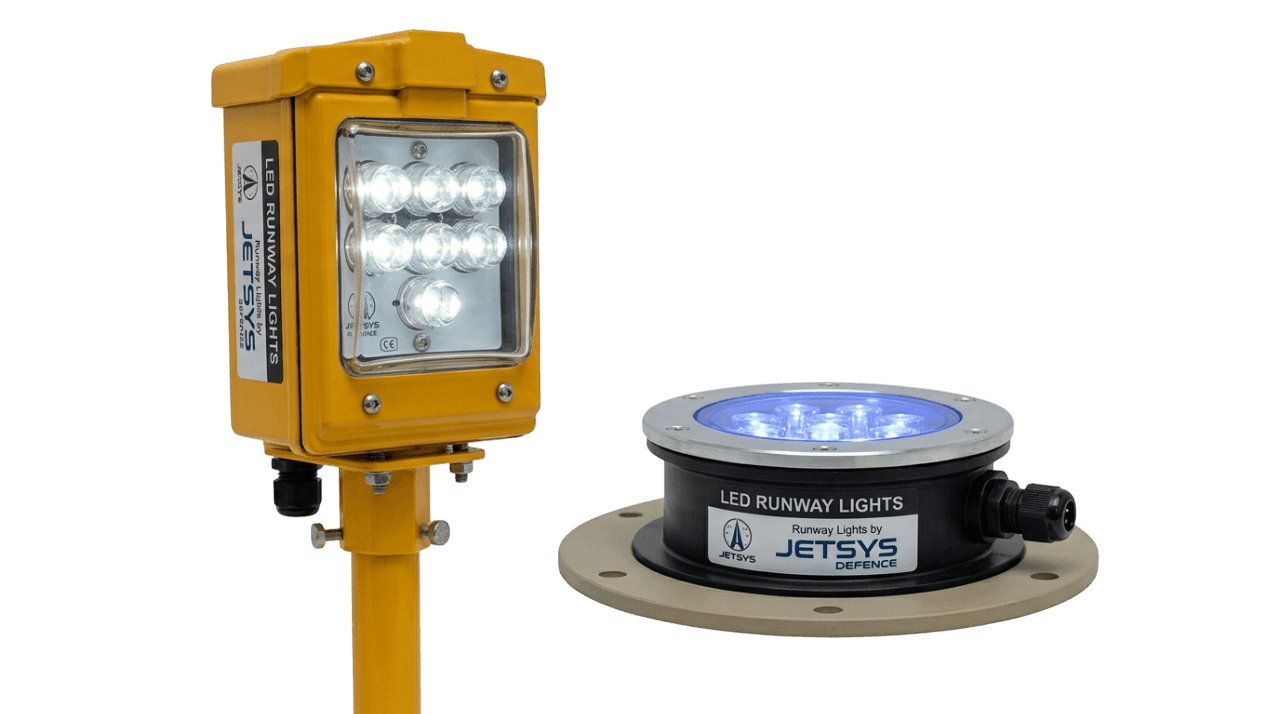
Introduction
Airfield ground lighting (AGL) gives pilots visual cues during landing, rollout and taxiing. Runway and taxiway lights work alongside pavement markings and airfield signs to guide aircraft. LED and halogen fixtures can serve the same lighting function when each meets the optical and installation requirements for that position.
For a new installation, start with the approved lighting layout and operating requirements. For a failed fixture, identify the installed model and approved replacement. For an LED airfield lighting retrofit, check the existing circuit and compare the cost of keeping it in service with the cost of conversion. Across all three projects, the right fixture depends on its function, beam performance, circuit compatibility and service-life cost.
LED vs Halogen Airfield Lights at a Glance
Compare fixtures that serve the same airfield function and meet the same optical requirements. For runway light power consumption, use documented models at equivalent intensity settings and include the circuit equipment affected by the change.
Scroll to see all columns
| Comparison factor | LED | Halogen | What to verify |
|---|---|---|---|
| Light output and colour | LED modules and optics produce the specified beam and aviation colour. | A filament lamp and optical assembly produce the beam. Coloured filters may be used. | Candela, beam coverage and colour limits for the same fixture function. |
| Dimming | The driver governs output as the circuit steps change. | Lamp output varies with the current supplied. | Output at each required step and consistency across the lighting pattern. |
| Power draw | Generally lower for equivalent fixtures. Driver and optional heater loads affect consumption. | Generally higher for equivalent fixtures. Actual draw varies by lamp and operating step. | Fixture input watts and total circuit power at typical operating steps. |
| Service life | The light source typically has a longer rated life. Driver, optics and seals also affect fixture life. | The lamp generally needs more frequent replacement. The housing may remain serviceable. | Rated life conditions, serviceable parts and anticipated replacement intervals. |
| Repair and replacement | Service may involve a driver, light engine or complete unit, depending on the model. | A replaceable lamp can simplify a like-for-like repair. | Approved spares, service procedures and workshop requirements. |
| Heat at the lens | Typically less heat reaches the lens. Heater options depend on the model. | Lamp heat can help clear the lens under some conditions. | Local icing exposure, lens clearing and heater load if applicable. |
| Existing controls | Compatibility depends on the driver, regulator, transformer and monitoring system. | An approved like-for-like unit can suit an existing halogen installation. | Regulator load range, transformer sizing, dimming and fault reporting. |
| Upfront cost | Include fixtures, installation and any circuit or control changes. | Cost may be limited to lamps or fixtures if the existing equipment can be retained. | Installed cost and scope for each option. |
| Operating cost | Lower power draw and fewer light-source replacements can reduce costs. | Recurring lamp changes and energy use can increase costs over time. | Energy, spares, labour and closure time over the same evaluation period. |
How LED and Halogen Airfield Lights Work
LED fixtures
A driver converts the available electrical input into controlled power for the LED light engine. Lenses or prisms shape the output into the beam required for the fixture’s position. The housing and heat-transfer components move heat away from the LEDs and electronics. Check whether the driver, light engine and optical assembly can be replaced individually, and where that work must be performed.
Halogen fixtures
Electrical current heats a tungsten filament until it emits light. Depending on the fixture, a reflector, lens, prism or filter directs the beam and produces the required colour. During an approved lamp change, maintenance teams typically check the lamp type, socket condition, optics and seals before carrying out the applicable return-to-service checks.
How the airfield circuit controls intensity
In a typical series AGL circuit, a constant current regulator (CCR) supplies the selected current step to the primary loop. Isolation transformers couple individual fixtures to the loop and isolate them electrically from it. Where monitoring is installed, the regulator or control system can report circuit faults or individual fixture status, depending on the design. An LED conversion needs to preserve the required intensity steps and fault indications across the expected loading range.
Where the Lights Are Used and Which Configurations Matter
Runway lighting
The approved runway design determines the positions, colours, beam directions and intensity requirements. Compare LED runway lights and halogen runway lights position by position.
Scroll to see all columns
| Fixture function | Purpose | Configuration to check |
|---|---|---|
| Runway edge lights | Define the sides of the runway. | Mounting style, aviation colour and any specified colour changes along the runway. |
| Runway threshold and end lights | Identify where the landing runway begins and where the runway ends. | Required colour in each viewing direction and whether the position calls for a combined fitting. |
| Runway centreline lights | Provide alignment cues along the runway. | Inset base, beam direction and colour sequence for the approved layout. |
| Touchdown zone lights | Identify the touchdown zone on runways equipped with this lighting. | Inset mounting, approach-facing beam and photometric requirements. |
Taxiway lighting
Taxiway edge lights typically use blue to mark the pavement boundary. Taxiway centreline lights generally use green to identify the route, with colour and beam changes where the layout requires them. Stop bars use red lights across designated holding positions and have their own beam, mounting and control requirements.
For a pavement-mounted edge installation, compare the LED and halogen options in the Taxiway Edge Inset Light family. Use the Halogen Taxiway Lights page when reviewing options for an existing halogen system.
Inset, elevated, and beam options
Inset fixtures fit into pavement bases where a low profile is required. Elevated fixtures sit above the pavement on approved supports where the layout and clearances permit. Specify mounting style, light source and beam direction separately. A directional fixture serves a defined viewing direction, a bidirectional fixture provides output in two specified directions, and an omnidirectional fixture serves positions requiring coverage around the fitting. Verify the base dimensions, mounting interface and required beam before selecting a model.
Industries and operating environments
At busy commercial airports, access windows can make the time required to service a fixture as important as the part price. Regional airports may prioritise local spare-parts availability and equipment that maintenance teams already know. Defence airfields may have project-specific operating and qualification requirements. Private aerodromes may weigh seasonal use, weather exposure and access to service support when comparing installed and operating costs.
Performance, Maintenance, and Cost Over the Service Life
Visibility, colour, and weather exposure
Compare the photometric reports for beam coverage, luminous intensity and aviation colour at equivalent operating settings. Fixtures with comparable measured intensity can look different because perceived brightness also depends on colour, optics and viewing conditions. Plan for contamination and standing water around inset optics. Where snow or ice is common, assess lens heat, any documented heater option and the airfield’s inspection and clearing procedures.
Service life, repairs, and downtime
The rated life of an LED light source is one input to the expected life of the complete fixture. Drivers, seals and optical assemblies have their own service requirements. Halogen maintenance typically includes lamp changes, while LED maintenance may involve driver, module or complete-fixture replacement, depending on the model. Both technologies need inspection, cleaning and checks for damage or water ingress. Factor in the time to gain access, perform the work, verify the fitting and release the affected area.
Upfront and whole-life costs
To estimate the cost of upgrading halogen airfield lights to LED, compare the same fixture count, annual operating hours, time spent at each intensity step and evaluation period. Include fixtures, bases or adapters where needed, installation, circuit and control changes, and acceptance testing. Add electricity, spares, labour and any costs associated with access or closure windows.
To estimate annual energy use in kilowatt-hours, multiply the circuit supply power in kilowatts at each intensity step by the hours spent at that step, then add the results. Use power at the circuit supply to capture regulator and transformer losses, and account for heater operation where applicable. This makes the airfield lighting life-cycle cost comparison more useful for deciding whether to replace individual fixtures or convert a complete lighting system.
Technical Specifications to Check
Optical specifications
Check the fixture function, aviation colour, luminous intensity in candela, beam distribution and directionality. Match the datasheet to the photometric report for the exact model and optical configuration. Check the colour limits, beam plots and documented performance at the required intensity steps.
Electrical and control specifications
Record the supply type and rated current, fixture input power at relevant steps, and the required isolation transformer specification. Confirm the CCR model, loading range and dimming behaviour. Check how the fixture reports a failure and whether the existing monitoring system can interpret it. If the model has a heater, include its electrical load and operating conditions.
Mechanical and environmental specifications
Check base dimensions, bolt pattern, mounting method and inset protrusion or elevated mounting height, as applicable. Review sealing, operating temperature, corrosion resistance and mechanical load rating for the installation. Match each required value to the proposed model’s datasheet or test report.
How to Choose Between Replacement and LED Conversion
Replacing a failed fixture
Start with the installed model or part number, fixture function, light source, colour, beam, mounting base and circuit details. An approved like-for-like replacement is often the practical option for an isolated failure. Before specifying a change of technology, check the approved replacement options, optical consistency across the lighting pattern, physical fit and electrical compatibility. Where FAA installation criteria apply, use the same light-source technology when replacing an individual failed fixture.
Planning a phased retrofit
- Inventory the fixtures by function, circuit and visual system.
- Review CCR and transformer compatibility under the proposed load for each phase.
- Confirm intensity steps, controls and fault reporting.
- Define the scope of each phase against the approved lighting pattern and permissible closure windows.
- Agree on acceptance checks for optical performance, controls and monitoring before returning each phase to service.
Two different questions determine phase boundaries. The electrical check establishes whether a circuit can support both loads. The operational check establishes whether the proposed combination is allowed within the visual pattern. Where FAA installation criteria apply, keep LED and halogen fixtures of the same type from being interspersed within the same lighting system.
Specifying lighting for a new installation
Begin with the approved lighting layout and operational requirements. If the project includes illuminated airfield signs, account for their electrical loads and controls in the circuit design. To compare equivalent fixture configurations or prepare a quotation request, share the following details.
- Fixture functions, quantities and required aviation colours, beams and intensity steps.
- Circuit type, CCR and transformer details, plus control and monitoring requirements.
- Base drawings or mounting dimensions, environmental conditions and access for servicing.
- Required test records, recommended spares and the planned installation window.
Jetsys Defence Configurations and Quality Documentation
Relevant Jetsys fixture families
Scroll to see all columns
| Jetsys Defence fixture family | Where to start |
|---|---|
| Taxiway Edge Inset Light | Review LED and halogen options for in-pavement taxiway edge positions. |
| Touchdown Zone Light | Review LED and halogen options for the touchdown zone and confirm the required optics and base. |
| Runway Inset Light | Review low-profile runway fixtures against your position, mounting and beam requirements. |
| Halogen Runway Lights | Start here when specifying an approved halogen runway replacement or associated spares. |
| Halogen Taxiway Lights | Review halogen options for an existing taxiway lighting system. |
Ask Jetsys Defence to identify the proposed model and confirm the available light source, beam, mounting and control options against your specification. For a replacement enquiry, include the existing part number and a base drawing if available.
Standards, testing, and manufacturing evidence
Identify the applicable DGCA Civil Aviation Requirements for Indian civil aerodromes, ICAO Annex 14 design requirements, and any FAA fixture specifications called for by the project. Aerodrome design requirements govern the lighting layout and performance. Photometric reports, environmental tests and certification or qualification evidence apply to the specific equipment offered.
Request an airfield lighting quotation from Jetsys Defence with your fixture schedule and required delivery date. Specify which documents and commercial details you need for review, including test reports, inspection records, part traceability, manufacturing origin, warranty terms and spares support.
Frequently Asked Questions
1. What is the difference between LED and halogen airfield lights?
LED fixtures use a driver and semiconductor light source. Halogen fixtures use a tungsten filament lamp. An equivalent LED fixture typically draws less power. Halogen fixtures commonly support lamp replacement, while LED servicing depends on whether the driver or light engine is replaceable.
2. Are LED runway lights brighter than halogen runway lights?
Either technology can meet a specified intensity and beam requirement. Compare candela and beam coverage at the same operating step. Perceived brightness can vary with colour, viewing angle and weather, so consistency across the approved pattern also matters.
3. Can a failed halogen runway or taxiway light be replaced with an LED fixture?
A technology change requires an approved replacement configuration and checks for mounting, circuit operation and consistency with the surrounding lights. Where FAA installation criteria apply, replace a single failed halogen fixture with the same light-source technology and evaluate LED as part of an approved system conversion.
4. Can LED and halogen fixtures share an airfield lighting circuit?
It depends on the regulator, transformers, controls and combined load. Check electrical compatibility and the permitted visual pattern separately. Even where a circuit can support both, the applicable installation criteria may require a uniform light source across fixtures of the same type.
5. Will existing regulators, transformers, and lighting controls work with LED fixtures?
Some can be retained when the proposed LED fixture is compatible with the existing CCR and isolation transformer. Verify the expected load range, output at each intensity step and fault reporting with the exact equipment models.
6. Are both technologies available in inset and elevated fixtures?
Both technologies are available in inset and elevated designs across the industry. For a specific position, check which configurations are documented for the required fixture function, beam and mounting interface.
7. How does maintenance differ between LED and halogen airfield lights?
Halogen servicing typically includes lamp replacement. Depending on the model, LED servicing may involve a driver, light engine or complete fixture. LED light sources generally have a longer rated life than halogen lamps. Compare the manufacturer’s ratings on a comparable basis and account for inspections, lens cleaning, seal condition and access time when estimating maintenance costs.
8. How do LED and halogen fixtures perform in snow or icing conditions?
LED fixtures typically generate less heat at the lens. Snow or ice can obscure either type, depending on the weather and installation. For cold-weather sites, check whether the proposed fixture has a documented heater option and plan inspection and clearing around local conditions.
9. How can an airport estimate the savings from an LED conversion?
Compare energy, spares, labour and closure costs over the same period. Payback occurs when cumulative operating savings cover the extra upfront cost of the LED option, including fixtures, installation, circuit changes and acceptance testing.
10. What documents should procurement teams verify before buying airfield lights?
Request the datasheet and photometric report for the exact model, any required test or certification evidence, and electrical compatibility documentation. Check the installation and maintenance instructions, spare-parts list and warranty terms before confirming the order.