
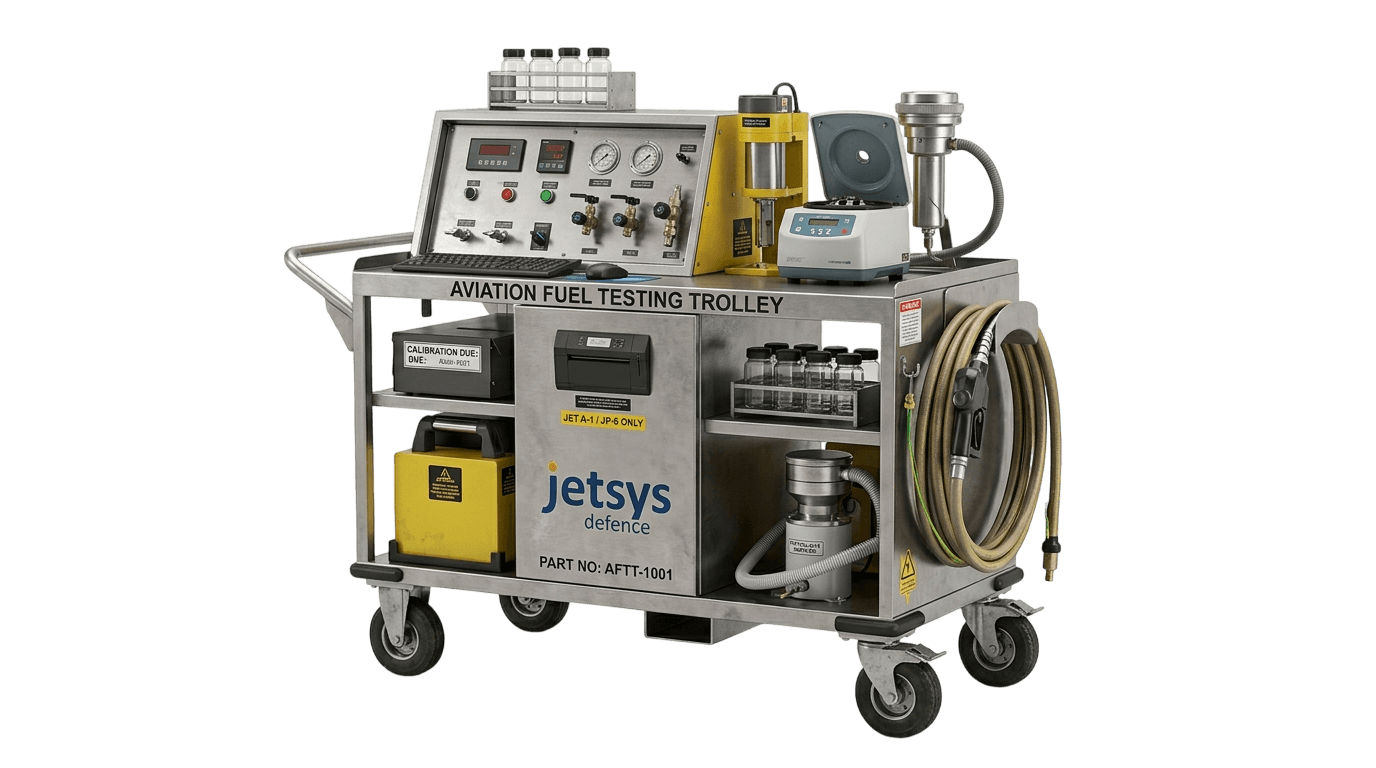
The right aviation fuel testing equipment depends on what you need to verify. At a fuel farm or refuelling point, that could mean screening Jet A-1 for free water and particles. In an MRO hangar or engine test facility, it could mean measuring fuel flow, pressure and consumption during an approved ground test.
This guide explains which instruments suit each task and what to specify when comparing equipment. For aircraft fuel system tests, Jetsys Defence offers configurable fuel consumption trolleys and aviation fuel ground support equipment.
What Is Aviation Fuel Testing Equipment?
Fuel Quality Testing vs Aircraft Fuel System Testing
Fuel quality testing assesses the fuel itself, including its appearance, contamination and physical properties. Aircraft fuel system testing measures how a system or component performs under specified conditions. It can verify whether a pump delivers the required flow, a regulator maintains pressure or an engine consumes the expected quantity of fuel during a defined test.
Field Screening, Laboratory Analysis and Functional Testing
Scroll to see all columns
| Test objective | Typical equipment | What the result helps determine |
|---|---|---|
| Screen a fuel sample at the point of use | Clear sample container, approved water detector or portable test kit | Whether a routine check meets its criteria or requires further investigation |
| Measure fuel properties against a specification | Density meter, membrane filtration apparatus or dedicated laboratory analyser | Whether the tested properties meet the applicable limits |
| Verify aircraft or component performance | Calibrated flow and pressure instruments, test bench or fuel consumption trolley | Whether performance meets the requirements of the approved test |
Aviation Fuel Quality Tests and the Equipment Used
Visual Appearance, Free Water and Sediment Checks
A clear and bright test for jet fuel uses a suitable transparent container to inspect a representative sample for haze, visible particles and separated water. Haze can indicate dispersed free water or fine particles. An approved jet fuel water detection kit can help detect dispersed free water when the fuel quality procedure calls for that check. Use the method specified for your sampling point and fuel grade.
Particulate Contamination and Membrane Filtration
In membrane testing, a measured quantity of jet fuel passes through a filter membrane that captures particles. A colour rating gives a screening result under the specified method. A gravimetric test measures the mass of collected particles relative to the volume tested. Specify aviation fuel particulate testing equipment according to the required result and whether the method uses line sampling or a laboratory sample.
Fuel Density, Temperature and Electrical Conductivity
Fuel density varies with temperature. A hydrometer and thermometer or a suitable digital density meter can provide readings for comparison at the specified reference temperature. A jet fuel conductivity meter measures the fuel’s ability to dissipate electrical charge. Select a meter and measurement range that meet the applicable method and reporting requirements.
Laboratory Tests for Flash Point and Freezing Point
A closed-cup flash point tester measures the temperature at which fuel vapour briefly ignites under defined test conditions. A freezing point analyser evaluates the fuel’s behaviour at low temperatures, where hydrocarbon crystals can form. These tests call for dedicated apparatus and the method specified for the fuel grade and test programme.
Types of Aviation Fuel Testing Equipment
Portable Fuel Sampling and Field Test Kits
Aviation fuel sampling equipment typically includes compatible containers, sampling accessories and labels for identifying where and when a sample was taken. A portable aviation fuel test kit can add a water detector or particulate screening equipment for checks at designated tank, filter or dispensing points. For a kit used across several locations, check which consumables each method requires and how they will be replenished.
Inline Fuel Quality and Contamination Monitors
Inline monitors can track selected conditions during fuel transfer or dispensing, such as water or particle levels, depending on the sensor. They can help operators spot changes between scheduled samples. Confirm the specified measurement range, installation location, alarm functions and the monitor’s role under your site’s fuel quality procedure.
Laboratory Fuel Analysers
Laboratory equipment includes digital density meters, specialised flash point and freezing point instruments, and membrane filtration apparatus for particulate analysis. Match the instrument to the specified test method, required precision and sample workload. For routine reporting, check how the instrument records results and ties them to the sample identifier.
Aircraft Fuel System Test Benches
A fuel system test bench provides a controlled setup for assessing components such as pumps, valves or regulators. Aircraft fuel flow and pressure testing equipment can combine metering, pressure control and data acquisition to record performance at specified test points. Define the component interfaces, operating range and data requirements before selecting a bench.
Jetsys Defence Fuel Consumption Trolleys and Fuel Ground Support Equipment
The Jetsys Defence aircraft fuel consumption trolley combines digital flow measurement and totalised readings with pumping, filtration and flow or pressure control. Configurations can be specified for ground-run fuel measurement and related duties such as fuel transfer, defuelling or circulation flushing. Optional data logging can capture how readings change during a test. Jetsys Defence also offers fuel transfer and filtration systems for operations that need dedicated handling or cleaning equipment.
Request a quotation from Jetsys Defence. Share the aircraft or test application, fuel grade, flow and pressure ranges, hose and coupling requirements, and any reporting or calibration needs. Ask for a configuration that covers the measurements and fuel-handling duties your team carries out.
How Aviation Fuel Testing Works
Fuel Sampling, Sample Identification and Traceability
Collect a representative sample from the point defined in the fuel quality procedure, using a clean container suitable for the fuel and test method. Record the sample ID, fuel grade, source or batch, sampling point, date, time and operator. Preserve this information when the sample goes to a laboratory so the result can be traced to the correct delivery or equipment.
Fuel Flow, Pressure and Consumption Measurement
A flowmeter measures the rate of fuel movement, a totaliser records the quantity that passes through it during the test, and a pressure sensor measures pressure at the specified point. In an approved setup with separately metered supply and return lines, net fuel consumption is the supplied quantity less the returned quantity over the same test interval. If the test reports mass from volumetric measurements, apply the density and temperature basis required by the test plan.
Data Logging, Test Reports and Acceptance Criteria
A useful report ties each result to the sample or test article, instrument, method and operating conditions. Record whether readings fall within the fuel specification or the aircraft or component test limits, as applicable. For functional tests, time-stamped flow and pressure data can help engineering teams identify when a reading changed and evaluate whether the system met its acceptance criteria.
Applications Across Aviation Operations
Airport Fuel Farms and Into-Plane Fueling Operations
Fuel farm teams use sampling and testing equipment during receipt, storage and transfer to monitor fuel quality. Into-plane fuelling teams use field checks and applicable monitoring at designated points in the dispensing system. Consistent sample identification helps trace a finding to a batch, storage tank, filter or dispenser.
Airline Maintenance and MRO Hangars
Maintenance teams use aircraft fuel system test equipment during troubleshooting and post-maintenance verification. A mobile trolley can bring calibrated flow and pressure measurement to an aircraft bay when the approved maintenance task calls for external equipment. Specify hose reach, coupling type and the required readings before assigning the unit to a fleet.
Aircraft Manufacturing and Engine Test Facilities
Fixed benches can support repeatable tests for pumps, valves and other fuel system components. During an engine ground test, a suitable metering setup can capture flow and consumption over defined test intervals. Agree on the required data resolution, export format and reporting units before the system is built.
Defence Aviation Maintenance
Defence maintenance teams may need mobile fuel ground support equipment for hangar and flight-line servicing. Specify the authorised fuel grades and platform interfaces, along with movement between work areas, site utilities and environmental limits. For a shared fleet trolley, confirm which fittings and measurement ranges apply to each platform.
How to Choose Aviation Fuel Testing Equipment
Fuel Grade, Test Objective and Applicable Test Method
Start with the fuel grade and the decision the measurement needs to support. Jet A-1 fuel testing equipment for routine visual checks has different requirements from laboratory equipment for a specification test. For aircraft maintenance, use the applicable approved task to define the required flow, pressure, consumption or component measurements.
Measurement Range, Accuracy and Repeatability
Specify the lowest and highest expected readings and the accuracy needed at critical test points. For aircraft fuel flow testing equipment, ask for performance across the working range, especially at low flow or when net consumption is calculated from two meter readings. Repeatability matters when results will be compared across maintenance visits or production tests.
Aircraft Interfaces, Fuel Compatibility and Operating Conditions
Confirm that hoses, seals and other wetted parts are compatible with the intended fuel. Document coupling types, connection points, hose reach and any return route required by the test setup. Include the operating temperature, available power, site requirements for bonding and equipment suitability for the installation area.
Portable vs Fixed Equipment for Your Test Location
Portable sampling kits suit work at distributed sampling points, and mobile trolleys can support aircraft across multiple bays. A fixed bench may suit repeated tests that use permanent pipework, utilities and data connections. Compare deployment time, floor space and test frequency at the locations where the equipment will be used.
Calibration, Consumables and Spare Parts Availability
Check calibration intervals and service arrangements when comparing quotations. For field kits and analysers, confirm the availability and shelf life of any detector capsules, membranes or other consumables your method requires. For fuel trolleys, include replacement filter elements, hoses, seals and meter servicing in your ownership costs.
Equipment Quality, Calibration and Documentation
Fuel Specifications, Test Methods and Aircraft Maintenance Requirements
A fuel specification sets the properties and limits for the grade. A test method specifies how a property is measured. Aircraft fuel system testing follows the aircraft or component’s approved maintenance or test instructions, including the setup, operating limits and acceptance criteria. State the applicable documents when requesting equipment so the quoted configuration can be evaluated against them.
Factory Acceptance Testing and Calibration Records
Agree on the factory acceptance checks for the supplied configuration. For a fuel trolley, these can cover metering across the agreed range, pressure control, leakage checks and specified alarms or shutdown functions. Request calibration certificates for the relevant instruments, with serial numbers, measured ranges and traceability to reference standards.
Equipment Inspection, Maintenance and Recordkeeping
Follow the equipment’s maintenance schedule for hoses, couplings, filters, sensors and control functions. Keep inspection, calibration and service records against each equipment ID. Document meter, sensor or component changes that could affect subsequent readings so test teams can verify the configuration in use.
Frequently Asked Questions
What equipment is used to test aviation fuel?
Typical equipment includes sampling containers, water detection kits, membrane filtration apparatus, density meters and conductivity meters. Specification testing can also require dedicated flash point and freezing point instruments. The fuel grade, sampling location and test method determine what is needed.
What is the difference between fuel quality testing and aircraft fuel system testing?
Fuel quality testing checks the properties and cleanliness of the fuel. Aircraft fuel system testing checks whether pumps, valves and fuel circuits deliver the flow and pressure required by the aircraft or component test procedure.
How is free water detected in aviation turbine fuel?
In Jet A-1 and other aviation turbine fuels, a visual check can show water droplets or a separate layer in the sample. An approved water detector can check for dispersed free water, according to the applicable method.
How is particulate contamination measured in aviation fuel?
A membrane test captures particles from a measured fuel volume. ASTM D2276 covers line sampling, and ASTM D5452 covers laboratory filtration. The applicable method determines how the result is obtained and reported.
When does a field fuel check need laboratory follow-up?
Follow the site quality procedure when a sample shows persistent haze, an unusual appearance, suspected cross-contamination or a result outside its screening limits. Laboratory testing may also be required when the fuel release process specifies properties that field screening cannot measure.
Why are fuel density and temperature recorded together?
Density changes with temperature. Recording both allows the result to be reported or corrected to the required reference temperature, often 15 °C, so it can be compared with the specification or batch certificate.
What does a fuel consumption trolley measure?
A fuel consumption trolley typically measures fuel flow rate and total quantity through its metering circuit. With the appropriate test configuration, those readings can be used to calculate net consumption during a defined aircraft or engine ground test.
How do I choose the right flow and pressure ranges for a fuel system test?
Use the approved aircraft or component test instructions to identify the required flow and pressure at each test point. Check that the equipment can measure accurately across the working range and handle the maximum conditions specified for the setup.
Which standards and test methods apply to Jet A or Jet A-1?
ASTM D1655 covers Jet A and Jet A-1. Jet A-1 can also be supplied against DEF STAN 91-091 or, in India, IS 1571, where specified. The governing fuel specification and quality procedure determine which test methods apply. Examples include ASTM D4052 for digital density measurement, ASTM D2624 for conductivity and ASTM D2386 for freezing point.
What calibration and test records should I verify before buying?
Check instrument serial numbers, calibration dates, measured ranges, results and traceability to reference standards. Review the factory acceptance report against the quoted configuration and confirm that the supplied documentation covers the equipment’s operation and maintenance.